

For a long time, the war to shed pounds has been framed as a personal failing—a lack of self-control or an easy misconception of “calories in versus energy out”. However, contemporary dietary science and endocrinology suggest a much more complex picture. In addition, Scientists now recognise that fat loss is hard, not due to a lack of trying but because of a deeply ingrained biological safety mechanism.
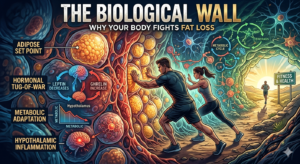
The Core Problem: The “Set Point” Theory
In addition,The main health reason for weight loss resistance is the Adipose Set Point Theory. This precept suggests that the frame has a pre-decided weight range that it virtually works tirelessly to hold, governed through the hypothalamus within the brain.
1. The Starvation Response
When you lessen your caloric intake, your body does not recognise your preference for a leaner frame; it perceives a famine. To ensure survival, it triggers a “metabolic adaptation”. This consists of a huge drop in your Resting Metabolic Rate (RMR), which means you burn fewer calories simply through rest.
2. The Feedback Loop: Leptin Depletion and Ghrelin Surging
As leptin drops and ghrelin rises, your mind receives a double signal to grow meal consumption and preserve energy, growing an organic “tug-of-war” that aggressively resists weight loss.
Result: In addition, you sense hunger an awful lot less after meals, and your brain becomes hyper-targeted on high-calorie meals.
The Culprit: Hypothalamic Inflammation
Recent research shows that our cutting-edge surroundings have “broken” our inner thermostat. Scientists attribute hyperpalatability, or the tendency to seek out highly palatable, extremely processed elements (rich in delicate fat, sugars, and chemical substances), as a primary driving force of hypothalamic contamination.
When the hypothalamus—the manipulative middle for hunger—becomes inflamed, it becomes “deaf” to leptin alerts. This condition, referred to as leptin resistance, prompts the mind to bear in mind the body is ravenous even when fat stores are excessive. This keeps the “set element” artificially extended, making it almost not feasible to maintain weight off through willpower by myself.
The Possible Solution: Resetting the System
In addition, while the biology of fat loss is daunting, scientists are identifying numerous “overrides” that may assist in decreasing the body’s set point and heal metabolic signalling.
The Nutritional Override: Synergizing Protein and Fiber
Moreover, to skip the body’s starvation defence, researchers emphasise prioritising nutrient density—in particular, fantastic protein and fibre—to clearly enhance satiety, restore intestinal health, and enhance insulin sensitivity.
Incretin Mimetics and GLP-1
In addition, one of the most progressive solutions in recent years consists of using GLP-1 receptor agonists. These medicinal drugs mimic the body’s natural hormones that signal fullness and slow down gastric emptying. By pharmacologically addressing the hormonal imbalance, those treatments assist in decreasing the set element, permitting the body to launch fat without the intense biological pushback of severe starvation.
Protecting Muscle Mass
Additionally, to counter the metabolic slowdown, scientists emphasise resistance education over traditional “cardio”. Muscle needs more energy, aiding long-term weight maintenance.
Summary
Furthermore, the issue of fat loss is a function of human evolution, not a pc virus. By transferring away from restrictive weight-reduction plans and in the direction of strategies that lessen inflammation and help metabolic fitness—along with prioritising protein, coping with pressure, and probably utilising clinical enhancements—we will in the end work with our biology instead of against it.

